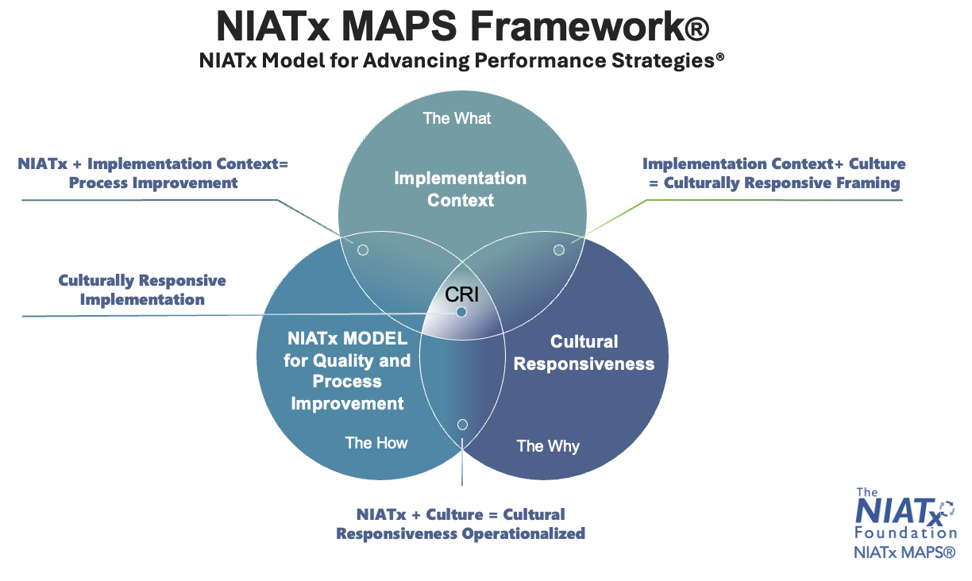
NIATx MAPS brings together context, culture, and process improvement so organizations can turn data and community understanding into practical measurable change. The framework begins with a structured intake process that helps organizations:
- Define improvement priorities.
- Identify the cultural and operational factors that influence success.
- Match support to their goals, readiness, and context. NIATx uses responses to the intake to align NIATx MAPS expertise, determine the appropriate support configuration, and shape the scope and sequencing of improvement work.
After the intake, the MAPS framework follows a 3-step process to implement culturally responsive organizational change:
STEP 1. WHAT: The organization determines what they are trying to improve by identifying the organization’s relevant fields, setting(s), and priority needs. This step focuses on accurately describing the implementation context, including where the work occurs and what outcomes matter most.
STEP 2. WHY: The organization identifies the cultural conditions that influence whether improvement efforts will be effective and selects the appropriate culture scope (e.g., broad cultural responsiveness, CLAS, community-specific). The MAPS framework treats culture is treated as a condition of effectiveness, not an add-on or afterthought.
Organizations also select the appropriate technical assistance (TA) level, which determines the depth and intensity of support
- Universal TA focuses on foundational guidance, shared learning, and broadly applicable strategies.
- Targeted TA provides more focused support for specific populations, settings, or challenges.
- Intensive TA offers sustained, hands-on support for complex contexts, high-need populations, or significant system change efforts.
Note that culture scope and TA level are selected independently and may be combined in different ways. This flexibility allows cultural considerations and support intensity to be intentionally aligned with the organization’s goals, readiness, and implementation context.
STEP 3. HOW: The organization determines how to implement process changes using one of the following options:
- Full NIATx MAPS Team: Some organizations that are new to structured improvement work, cultural responsiveness, or implementation across complex settings need a full NIATx MAPS team to support foundational skill-building, shared understanding of the field and setting, and practical application of improvement methods. Under this option, NIATx provides a three-person team with complementary expertise in process and quality improvement, implementation context, and cultural responsiveness. This approach is especially helpful when building capacity from the ground up or working across multiple systems or population.
- Targeted NIATx MAPS Support: Some organizations that already have deep expertise in their field, setting, and evidence-based practices require more targeted support. For this option, NIATx employs a two-person team with deep expertise in process and quality improvement and cultural responsiveness to complement internal capacity and contextual knowledge. This configuration allows teams to move efficiently deepen implementation effectiveness and strengthen cultural alignment without duplicating existing expertise or capacity.
Support is flexible. The goal of NIATx MAPS is to provide the right level of guidance to help teams move improvement work forward and sustain results. Importantly, NIATx MAPS treats cultural responsiveness as a condition for success to ensure services are relevant, engaging, and effective for the populations the organization serves. At the same time, it grounds improvement efforts in the organization’s realities, including staffing, systems, and external pressures that affect implementation and sustainability.
Learn more about NIATx MAPS…